You'll actually look forward to your morning commute. Life is calling. How far will you go? Learn more about the Peace Corps

Wednesday, February 23, 2011

My Brazilian Adventure Part 3

So, of course I got busy and stopped writing about my trip to Brazil. I will try to summarize the rest of it quickly.

We ended up moving to another campsite due to our disappointment with the first one and a desire to see more of the island. Because we didn't really understand the bus routes we asked what the best way to get to the next place would be. Although the campsite is pretty popular most people didn't seem to understand where we wanted to go and we ended up spending a total of 4 hours on 3 different buses to get there. Upon arrival it started to drizzle so we hung out in a pavilion and played Farkle while we waited out the rain. The campsite turned out to be the only state-owned and operated campsite in Brazil. It was much larger than our previous site and much better maintained, it was called Camping Rio Vermilho. Which means Red River Camping. We ended up staying at this site for the duration of our stay. There was a small town located about 30 minutes up the beach where we were able to buy groceries and go out to eat.

On our first day on Praia Mozambique, which is the longest beach in Florianopolis, Kristin and I decided that we'd like to try surfing. Initially we figured we might rent a board for the day or half the day and maybe even get a lesson. We checked out the first Escuela de Surf on the beach and were told that boards rent out at 20 reales or about $12 per hour. Then we saw a board sticking out of the sand with a for sale sign on it. 30 Reales! We quickly bought it. It was pretty beaten up and much too small for learning, but hey, we knew we weren't going to become experts. We just wanted to have some fun. The boys we bought it from, who were about 12 years old, waxed it up and sent us on our way. We spent the day playing in the waves, attempting to surf, but mostly just riding in on our stomachs. The next day we sold the surfboard to a group of Argentines for the same price. It was perfect!

After selling the surfboard we hiked to a nude beach, which turned out to be more of a gay nude beach. There were few women and all of them were fully clothed. We didn't spend much time there. As we crossed the path back to our beach a storm rolled in. I led the way down the path through the cold pelting rain and stepped poorly turning an ankle. The rest of the walk back to town was not pleasant. My ankle swelled quickly and has yet to heal completely.

The following day we took a trip to the northern coast to a much more crowded beach called Praia Inglesas. There the water was warmer and the people were packed like sardines onto the soft white sand. There were vendors of all types. They sold everything from cheese on a stick to jewelry. We tried some coconut covered in chocolate and churros, yum!

It rained nearly every day of the trip and the last one was no different. Luckily these rains were light and usually only lasted a few hours. We decided that in order to catch our 5 pm bus back to Paraguay we should leave around 3. We packed up the tent and all of our stuff and headed to the bus stop. By the time we arrived at the local terminal in the centro it was 5:05, we raced the 2 blocks to the long distance terminal only to find that our bus had already left. Luckily the agency was able to put us on the next bus out for minimal cost and we got to stay a little longer in Brazil.


The buses we rode in and out on.


Waterfall we hiked to on the first day.


Our hostel from the first night


Natalie and I on the path to the beach from Campsite #2


Kristin and I taking the surfboard out.


Beach Bar


Home Sweet Home


At the top on our hike to the nude beach


The Storm coming in


Praia Inglesas


Yummy steaks we cooked up


Brazilian meals are monstrous


With our surfboard

Saturday, January 22, 2011

My Brazilian Adventure Part 2

Before heading to Brazil Kristin, Natalie and I decided to try and make the trip as economical as possible. Seeing as it was a relatively last minute decision, we didn't have it planned into our budgets. So we did a little research and seeing as accommodations tend to be the most expensive part of the trip we planned to camp as much as possible. Camping on the beach is illegal, but there are several campsites around the island of Florianopolis where you can pay to camp. The first night however we splurged and made reservations at a hostel in the south part of the island called Costa de Dentro. There we were able to get our bearings and more information regarding the camping options. In order to get to Costa de Dentro and the Alburgue do Pirata, Pirate's Hostel, we needed to catch a bus.

Living in Paraguay we are accustomed to taking buses to get anywhere we can't go on foot or bicycle. The buses in Paraguay are old and rusty, usually imported from some other South American country where they were used until the death, then revived for used around here. In Brazil it quite a different experience. In order to get to Costa de Dentro we needed to take two buses total.

After our arrival in Florianopolis we walked around a bit, checking out some of the shops and eating lunch at a small outdoor restaurant. Then we headed to the terminal to get the first bus headed south. Luckily we arrived just as the bus was getting ready to leave. We quickly paid for the tickets and jumped on the crowded bus, without much time to look around. The bus was crowded to the point of standing room only. Lucky for us the trip was only about 30 minutes. Loaded down with our backpacks we were obviously foreign tourists. The other passengers on the bus were nice, letting us put our bags at their feet.

When we got to the second terminal we found that there are accurate bus schedules posted, something you definitely won't see in Paraguay. The next bus we needed would leave in about 20 minutes. Also the transfers are free there, as long as you stay in the terminal. What a relief, bus trips sound cheap, but can definitely rack up quickly. We looked around the terminal and found that it included clean bathrooms and water fountains, oh how I have missed water fountains. I filled up my water bottle and pulled out my guampa and bombilla to drink some terere while we waited. As the time neared for the bus to leave a line formed, now that's definitely not something you'd see in Paraguay. People here push to get in front of each other and onto the bus. We hopped on with everyone else and headed to our hostel.

The hostel was quaint and quiet. It was also pretty full. There was a small shop down the street for groceries and the beach was just a few blocks away. The sky was overcast that day, but we still went to explore. We walked around on the beach and jumped in the water. Then headed back to the hostel. That night we made friends with some Australians, taught them how to play farkle, and we looked for camping nearby. We were told there is camping in Armacao, a beach we passed on the way down. We decided to head there the next day.

In the morning we started the day with a hike to a nearby waterfall where the water was cool and clean. It was beautiful. Then we packed up our stuff and went in search of the campsite. We waited for the bus across the street from the hostel and when the bus came, stuck our arms out, signaling that we wanted to get on. The bus blew by. What?! We were puzzled by this. Why didn't it stop? Then we looked around and noticed a bus stop sign about 50 meters away. So in this country you actually have to be at a bus stop for it to stop, sounds logical, I guess. We walked to the next stop and waited for about an hour for the next bus to come by. This time we were successful in boarding.

The bus let us off in Armacao and we asked around to find the campsite. It turns out the campsite was merely a patch of grass on an empty lot. There were some bathrooms and pavilions with kitchens, but the tents were packed in, with little personal space. But it did have access to the beach and was just a quick walk from the town. We immediately decided to stay only one night. We set up the tent, locking our stuff inside and headed out to do more exploring. We ate an enormous Brazilian lunch of pan-fried fish, rice and beans, fries, salad and a Caipirinha strong enough to intoxicate after only a few sips.

After stuffing ourselves with food we went to check out a hike we saw on the map, rumored to be about an hour long and leading to a private beach. After walking along the beach, this one more crowded than the first one we'd seen, we found the path and started along it. After going off on the wrong trail a few times we found the right one, but by then the sun was starting to set. We ran into a couple returning from the other side. They indicated that the last boat that returns from the beach had already left and that we should turn around because we probably wouldn't make it back before dark. We continued on for a few more minutes, then turned around. We played on the beach awhile and were amazed by how many people were there drinking mate, the hot version of terere. It turns out most of the tourists in Florianopolis are Argentinian and Uruguayan and they drink as much mate as the Paraguayans do terere, even on the beach. After returning to the campsite we made some guacamole and caipirinhas for dinner and headed out to the beach to enjoy its proximity. We climbed up into a lifeguard station and watched as the other tourists went about their business. Some walking on the beach and others getting more intimate. It was a great first few days in Florianopolis.

Tuesday, January 18, 2011

My Brazilian Adventure, Part 1

Paraguay is bordered by 3 countries, Argentina, Bolivia and Brazil. Until last week I had only ever ventured into Argentina; not because I didn't like the idea of seeing the other two, more because in Argentina you don't need a visa. Getting a visa while in the states is probably time consuming and annoying, but not too difficult. In Paraguay however, obtaining a Brazilian visa nearly brought me to tears.

I decided during the week between Christmas and New Years that I would join my friends Kristin and Natalie on their trip to Brazil. Natalie speaks fluent Portuguese and I determined that it would be advantageous to travel with her. We hoped to leave as soon as possible and turned in the required vacation request forms to the Peace Corps office immediately via a friend who happened to be heading into Asuncion. Then I set about getting the visa. As the United States requires most foreigners entering the country to obtain a visa, Brazil reciprocates by requiring Americans to do the same. Kristin and Natalie each had theirs already.

The visa has a cost of $190, more than half my monthly living allowance. They also require financial paperwork, photos of a specific size and background, round trip tickets showing when you will enter and leave Brazil, and the location where you will be staying. Of course, the closest consulate is located three hours away in Asuncion and the visa takes several days to process. I decided to go into one day and apply for the visa, then return a few days later to pick it up.

Obtaining the visa was much like a scavenger hunt or following a treasure map, I needed to collect all the required items and get to the consulate before it closed at 2. First item of business, get to Asuncion. Because it was holiday time the buses were laden with travelers and I spent the hot and sweaty 3 hour ride to the capital crammed in the aisle among other passengers without a seat.

Upon arrival in Asuncion I started at the bus terminal where I bought my round trip ticket, but only after convincing the woman at the counter that I couldn't show her my Brazilian visa because I needed the ticket in order to get the visa and that I would show it to her after obtaining it. Tickets tucked safely away in my bag I headed to the next stop, Mariscal Lopez mall for pictures. The actual picture taking went quickly, but they said it would be at least an hour until they'd be ready, previously I had obtained them in only a few minutes. I decided to run to get the financial paperwork while the photos were processing. After a quick trip to the PC office to print out financial info I was back to pick up my photos and off to the consulate. By this time it was nearly one.

Upon arrival at the consulate I took a number, similar to the ones at the meat counter, and waited my turn. Even though I was the only person in the waiting room, it took nearly 20 minutes for the woman at the counter to talk to me. When I was finally called over she took one look at my passport and told me that I could not get a visa. Why? I asked, devastated that I had rushed around all morning only to be denied. I was lacking sufficient pages in my passport for the addition of a visa. I reluctantly collected my passport and sulked back to the elevator and out the front door.

What do I do now? I headed to the US Embassy hoping they'd be able to add pages to my passport. As I waited in the consulate office, I scanned the list of prices. $82 for the addition of passport pages! Great, I thought, now I will really be broke. Luckily when they returned the passport nearly an hour later I was reminded that the Peace Corps passports are no fee, which includes the addition of pages. It was now past three and there was no hope for getting the visa. I would not be able to get it until the following week and our trip would have to be postponed.

The next Monday I set out on my quest once again and things went much smoother. I already had all the required items. I even got a seat on the bus. I went straight to the consulate completed the visa request, went to the bank to pay the fee, returned to the consulate to provide the receipt and was told that I could return Thursday to pick up my passport.

I changed my ticket to leave Friday, luckily there was no fee attached, but the attendant stressed that I could only change it once. She also was unable to change my return ticket at the same time because she didn't have any more ticket paper to print on.

I picked up my passport Friday morning and headed off to Brazil an hour later. But not before getting the great news that I had done better than expected on my LSAT. That certainly cheered me up and my vacation started out wonderfully.

The bus ride was long. Nearly 24 hours, which was about 4 hours longer than we had been quoted. And although it cost more than the nice bus to Buenos Aires and traveled nearly the same distance, the bus did not include any meals, had no foot rests, but did include an annoying 2 year old child who was traveling with her teenage mother. The bus picked up my traveling companions in Coronel Oviedo, where the driver ate lunch and everyone got off to use the bathroom, we knew then that it would be a long trip.

The border in Ciudad del Este always promises to an amusing experience. The border is open and most people pass freely. There are no agents who get on the buses to check that everyone went through immigrations and no list like at the Argentine border. In fact you actually have to insist that the driver stop to let you off local buses passing into Foz, otherwise you will end up in Brazil illegally. Many people stayed on the bus, while others got off to do things the legal way. In the immigrations office my friends and I got to the front of the line and the border agent looked through our passports, stamped them, and then began a frantic search for a pen. He had to sign the stamp and it was obvious we were his first passport holders of the day. We let him borrow a pen then boarded the bus to head to the Brazil side. There the lines were longer. The Brazilians are slightly stricter with the immigrations process. Somehow we managed to pick the short fast moving line and even after using the restroom ended up on the bus nearly 20 minutes before the rest of the passengers.

The rest of the bus ride was pretty uneventful. We stopped several times for bathroom breaks and food. The girls had bought salami, cheese and crackers as well as some other snacks for our dinner. We enjoyed that and a couple of boxes of wine and tried to get some sleep. When we arrived in Camboriu, about 2 hours north of Florianopolis, most of the passengers got off the bus. Its a popular vacation destination for Paraguayans which freed up the seats to spread out. We continued to Florianopolis and breathed sighs of relief when we disembarked. Yay! We made it! Now the real adventure begins.

Wednesday, January 5, 2011

Waiting

Waiting, waiting, waiting. I thought I had mastered the waiting game. I am a Peace Corps volunteer, we spend the better part of two years waiting. Waiting for buses, waiting for the rain to go away, waiting for projects to take shape. But here I am checking my email every half hour, trying to fill the time in between with tasks like washing clothes. I am waiting for my LSAT score to appear. I feel like I need to know my score. It is pretty important. It will help determine where I should and should not apply to law school, whether or not I will receive scholarships and of course my self worth for today, that is if it comes out today.

But I also don't want to see it. Every time I hit refresh my heart and stomach do somersaults. Will it be there? Please let it be there! No, no, I don't want to see it. I fear that my score will be lower than the one I got in 2005 as a college senior. In five years I must have improved my logical reasoning and reading comprehension, right? Or maybe I have been out of school too long and my rusty study habits failed me.

I made the trip to Buenos Aires in December to take the test way back on the 11th. It seems like ages ago. After nearly 24 hours on a bus and two days of walking around rainy Buenos Aires I took the test at a cultural center, where in good South American fashion the proctor turned up an hour after the scheduled time. The test takers, me included, had spent that hour trying to keep ourselves calm, doing breathing exercises, stretching, using the bathroom a million times. Air conditioning is a rather new concept down here and so of course it was cranked way up, causing the temperature to plummet. While my frozen fingers gripped the pencil, I silently thanked myself for bringing along a jacket and raced through the questions of the test. I did the best I could, I think. I didn't feel positive or negative about it when I left, just relieved that it was over.

Wow, still not posted. It has been nearly a month, of course the website states the scores will be released on the tenth, but every year they come out early. Here I am trying to keep busy, I even washed my tennis shoes, to keep my mind off my pending score. But I constantly ask myself, will today be the day? Will I be able to give myself some direction today? There are always those scholarship essays that aren't going to write themselves. But I know there's no point if I didn't do well on the test. I want to know, I need to know.

Thursday, December 30, 2010

Solidarity

Before coming to Paraguay solidarity was not a word that often appeared in my vocabulary. I knew what it meant and thought of it in relation to Girl Scouts or perhaps ideals presented by political parties. Its not one of those words that pops out when you ask an American about his or her values. But here in Paraguay when you ask someone that same question solidarity tends to be one of the first that they list. For a long time I assumed this was something they had learned early on in school, one of the many things they memorize from the age of five to spit out when someone asks. And maybe it is, but in recent months I have learned that when things get rough they actually do come together and show their solidarity.

On November 7th, the day of the big municipal elections, a fire consumed three houses in a marginal neighborhood called an asentamiento. The asentamientos are small neighborhoods of government or donated housing that everyone claims are super dangerous, mostly because they are full of people poorer than themselves. The next day, Monday, Radio Coronel Oviedo, where I host a weekly radio program, conducted a drive for donations to replace what was lost in the fire. There were donations of everything from clothes, to furniture to building materials. A young girl lost her bike in the fire. The bike had been used as transport to sell cooked yucca/maniac around the neighborhood, one of the few sources of income for the family. Several bikes were donated to the little girl so that she would still have transportation. The houses are nearly rebuilt now.

Just a few weeks later my neighbor's house burnt down. The next day the radio repeated its donation drive for the victims. Although many had given just weeks before, people from the town opened their hearts and donated to this newly homeless family. Everything from a crib for the baby to materials to rebuild, just about everything that could be replaced was. While the home was engulfed in flames neighbors and friends ran in and out carrying whatever they could grab. As in most Latin American countries the firefighters are volunteers and don't have many resources, but they were on the scene quickly and worked hard to put the fire out.

The community really seems to come together in times like these. They give support to their fellow citizens whether or not they know the victim. Often times I see the negative things about Paraguay while living here, such as the rampant gossip and even more prominent corruption, but I also see that Paraguayans are generous and loyal. And when they list solidarity as one of their values, they mean it.

Monday, November 22, 2010

A New Face at the Muni

Ok, so it’s been awhile and you may be wondering, what exactly is Melissa doing down in Paraguay? I have been hard at work and also not so hard at work since returning to Paraguay after a month of home leave in July. I have managed to accomplish my goal of creating a new Youth Secretary position at the town hall and I have also been enjoying working when and where I want.

The Youth Secretary, along with the Youth Parliament, took some work to get going, but now we are well on our way to becoming a stable entity. The first step was planning a forum where more than 100 local youth participated in needs assessments and democratically elected three candidates for the Youth Secretary position. Then I had to nag the mayor to choose between the three candidates. Finally on September 1st, only three and a half months after the forum and one year after I initially heard about the project, a resolution naming the Youth Secretary was signed. The resolution also established the Youth Department at the Municipality and the Youth Parliament.

Since the establishment of the department we have planned several events. The first was a celebration for annual Youth Day on September 21st. Together with the Associacion de Rock Ovetense we planned a rock concert that was held in front of the Town Hall.

The Set-up

The Concert

Eco Ajos, an environmental youth group

Parliament members working hard


Next we planned a debate for the candidates for mayor, held on October 20th. Three of the five candidates were present. There were over 200 people in the audience.

Martin Giret, the democratically elected Youth Secretary

The Youth Parliament and Candidates

Signing a Promise Letter to continue with the Democratic Election of the Youth Secretary

Debating


We are currently planning events to support World AIDS Day on December 1st.

You can join our group and see more pictures on Facebook by searching for Secretaria de la Juventud, Coronel Oviedo.

Monday, August 23, 2010

Finally a Project Well Done

Week after week I went to Gotas de Leche, the community center that I was assigned to work with for the duration of my two-year service. I spoke with the kids and with their mothers searching, seeking any project that would occupy my time and benefit the families. For months I came up with nothing. I was already working with the youth group, but lets face it, working a couple of hours on Saturday mornings just wasn’t going to cut it. I found work in other institutions, but still felt like I needed to do more at Gotas. I conducted two cooking classes with the mothers and had a summer reading club for the kids, still I lacked tangible change. The parents commission started to feed lunch to the children once a week. They started talking about the possibility of a comedor, like a soup kitchen for kids. Finally I saw my in.

Where would we do this? When? How? They had petitioned the municipality for money at the yearly project presentation and were approved for some money, but its been over a year and they still haven’t seen it. Ah-ha! I remembered the Small Project Assistance Grant (SPA) that is offered through the Peace Corps and funded by USAID. We would just need to fill out the paperwork and present the project and with a little luck we’d be granted up to $5000 to build the building. I spoke with the commission president who said “Great! I’ll fill out whatever paperwork you need, just as long as we can get something built already.”

Then I found out that another volunteer who works with the same NGO was planning the same project through the NGO. We talked it out and decided that it would be best for the parents to take ownership of the project, rather than be handed something else by the NGO. So Angelic and I met with the commission in late December and started in on the list of questions that needed to be answered for the grant application. About three questions in the complaints started. “Its hot, how many more questions?” they asked. Angelic and I looked at each other and smirked, we had a feeling this was going to happen. We had barely started the preliminary questions, we knew we’d be on our own for most of the actual writing of the proposal. We got the basic information and then worked out the details together. We had decided to build a pavilion like structure that could be used as a multipurpose space where they could feed the kids. Eventually the space would be equipped with the necessary equipment to turn it into the comedor.

The applications are typically accepted each month, of course, we worked several long days to complete the application for the January deadline only to find out they aren’t accepted in January so we’d have to wait until February. That’s okay we decided that we could improve the application for February. It was turned in after being reviewed by both our supervisors and awaited the committee’s approval. In March we were notified that it was indeed approved and the money would be available some time in April. Yes, we started the process in December but weren’t able to actually start the project until April. That’s how quickly things work in Paraguay.

On the day the money arrived I went with the commission treasurer to pick up the check. Obtaining $5000 to construct a building is a huge thing for a group in Paraguay to have accomplished, but rather than a grand ceremony with the handing over of the check, as it would have been with any other organization, we merely walked into the administration office where we signed for the check and walked out with it. The whole process took a total of two minutes, maximum.

We headed back to Coronel Oviedo and met with several contractors to decide who would direct the construction. Our original contractor had recently had an accident and was unable to work. The parents were expected to volunteer labor hours in order to keep the cost down and donate the required 30% contribution for the grant. We decided to go with a father from the community center who gave us a price within the budget. The ground breaking was held just a few days later. Of course, there we did have a ceremony in which commission members, the director of the NGO, and I each had a chance to break ground. I was surprised when I arrived at the ceremony to find that the plan for the structure we were to build was not located where I had apparently assumed it would be built, but right in front of the existing structure. Although I was not in agreement with the placement I figured that as their project they had the right to decide where to put it.

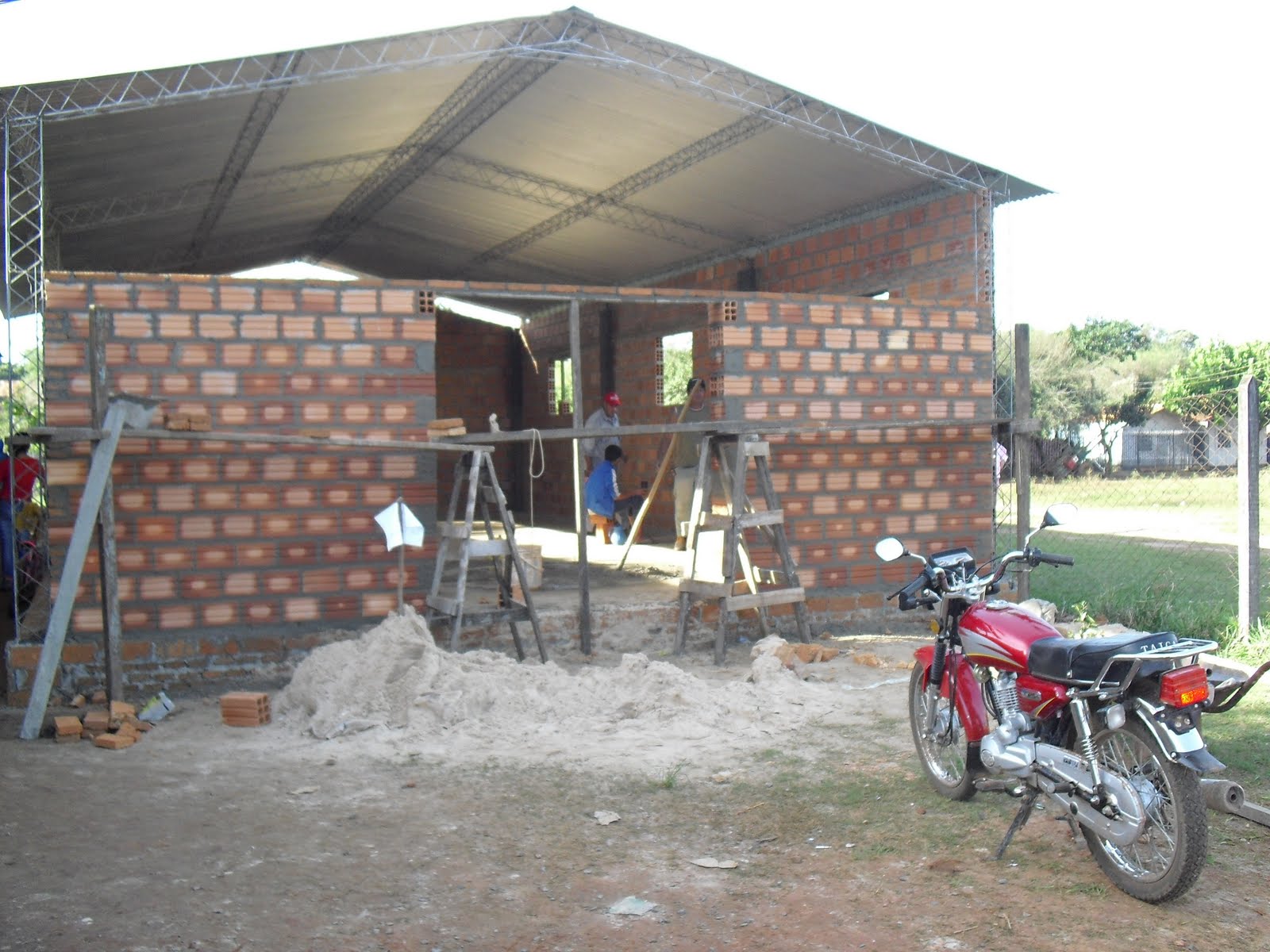
The actual construction process was extremely quick. The construction began in early May and was finished by mid-June, even though there had been several days of rain. The commission was required to meet weekly during the process in order to make decisions regarding the construction and in the end plan the inauguration event. Several parents contributed their time during the construction and there were few problems during the process.

The inauguration took place just a few days before my trip to the states and was considered my going away party as well, seeing as I would no longer be working with the community center during my extension. We invited all the big shots including the mayor, governor, and Peace Corps country director. In the end my supervisor’s assistant and coordinator were the only outsiders who attended the event. There were several children who gave speeches and performed traditional Paraguayan dances. I gave a speech during which I began to cry and couldn’t continue, I had never expected to become that emotionally attached to the community center, but I had and I had also finally accomplished something big at Gotas de Leche. It was a wonderful departure and a job well done.


A few days into the construction


Bricklaying


A grandfather helping out


Building the frame


Putting on the roof


First event in the construction, Mother's Day Celebration


Walls going up


Almost done!


The inauguration


My speech